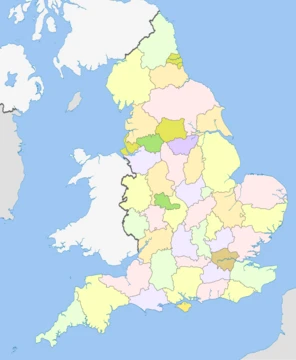
West Sussex
Ceremonial county in South East England, sunniest in the UK.
West Sussex is a ceremonial county located in South East England. It shares borders with Surrey to the north, East Sussex to the east, Hampshire to the west, and the English Channel to the south. The county’s biggest town is Crawley. Covering an area of 1,991 square kilometres, West Sussex had an estimated population of 915,037 in 2024. Most of its largest settlements sit along the coast, including Bognor Regis, Littlehampton, and Worthing—the last two being part of the Brighton and Hove built-up area, which stretches into East Sussex. Inland, the county is mostly rural, with towns like Crawley and Horsham in the northeast and the city of Chichester in the southwest. For local government, West Sussex is a non-metropolitan county split into seven districts. Historically, West Sussex and East Sussex were one county, simply called Sussex.
A key feature of the landscape is the South Downs, a chalk escarpment that runs east to west across the county, separating the north from the south. To the north, the downs drop steeply into the Weald; to the south, they slope more gently toward a narrow strip of flat land between the hills and the coast. This coastal strip widens toward the west, where it is broken by Chichester Harbour, a ria.
People have lived in this area since the Lower Paleolithic era. During the Roman conquest of Britain, the Romans took over the local Britons, the Atrebates, and made the region a Roman province. In the Early Middle Ages, Saxons settled here, founding the Kingdom of Sussex in 477. That kingdom lasted until around 827, when it was taken over by Wessex. Today, West Sussex is home to Gatwick Airport, the second-busiest airport in the UK by passenger traffic. The county also boasts several stately homes, such as Goodwood, Petworth House, and Uppark, as well as castles like Arundel Castle and Bramber Castle.
The name Sussex comes from the Old English 'Sūþseaxe', meaning 'South Saxons', and dates from the Saxon period between 477 and 1066. Human habitation in the area goes back even further, to the Old Stone Age. The oldest hominin remains ever found in Britain were discovered at Eartham Pit in Boxgrove. Prehistoric sites include the Devil's Jumps, a group of Bronze Age burial mounds, and the Iron Age hill forts of Cissbury Ring and Chanctonbury Ring on the South Downs.
During the Roman period, Fishbourne Roman Palace and rural villas lik
- area
- 1,991 square kilometres (769 sq mi)
- population_2024
- 915,037
- largest_settlement
- Crawley
- county_town
- Chichester
- highest_point
- Blackdown
- sunniest_county
- United Kingdom (1902 hours per year average to 2011)
Lore & Background
West Sussex has a long history of human settlement dating back to the Lower Paleolithic era. The oldest hominin remains known in Britain were found at Eartham Pit, Boxgrove. During the Roman conquest, Romans conquered the Atrebates, the indigenous Britons, and incorporated the area as a Roman province. The Romans built Fishbourne Roman Palace and rural villas such as Bignor Roman Villa, along with a network of roads including Stane Street. They used the Weald for iron production on an industrial scale. During the Early Middle Ages, Saxons settled the area, establishing the Kingdom of Sussex in 477, which lasted until c. 827 when it was annexed by Wessex. The foundation story is regarded as somewhat of a myth by most historians, though archaeology suggests Saxons did start to settle in the late 5th century.
Reader's Guide
West Sussex is significant as a county that combines ancient history with modern infrastructure. It is home to Gatwick Airport, the UK's second-busiest airport by total passenger traffic. The South Downs are a defining feature, crossing the county from east to west and dividing the north and south. The county has a number of stately homes including Goodwood, Petworth House and Uppark, and castles such as Arundel Castle and Bramber Castle. For local government purposes, West Sussex is a non-metropolitan county with seven districts. The county is the sunniest in the United Kingdom according to Met Office records, averaging 1902 hours of sunshine per year over 29 years to 2011. Its coastal settlements, including Worthing, Bognor Regis, and Littlehampton, form part of the Brighton/Worthing/Littlehampton conurbation. The interior is generally rural, containing the towns of Crawley and Horsham in the north-east and the city of Chichester in the south-west.
Did You Know?
- The oldest hominin remains known in Britain were found at Eartham Pit, Boxgrove in West Sussex.
- West Sussex is the sunniest county in the United Kingdom, averaging 1902 hours of sunshine per year.
- Gatwick Airport, located within Crawley, is the UK's second-busiest airport by total passenger traffic.
- The Kingdom of Sussex was established in 477 and lasted until c. 827 when it was annexed by Wessex.
More in English Counties 25-39
Elsewhere in the English Counties universe
Spotted an error? Know more?
This is a living reference — every entry is fact-audited, and reader corrections feed straight into our audit queue. Suggest an edit · See this site's audit record