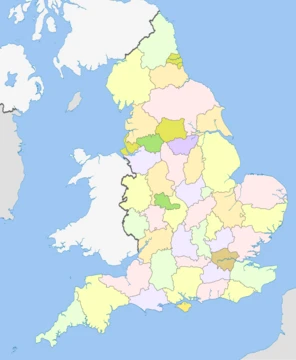
Norfolk
A rural English county with a rich medieval and agricultural heritage.
Norfolk (pronounced NOR-fək or NOR-fuuk) is a ceremonial county in eastern England, part of both the East of England region and East Anglia. It shares borders with Lincolnshire and The Wash to the north-west, the North Sea to the north and east, Cambridgeshire to the west, and Suffolk to the south. The county’s largest settlement is the city of Norwich, located in the centre-east. Other principal towns include Great Yarmouth on the east coast, Thetford in the south, and King’s Lynn in the north-west. For local government, Norfolk is a non-metropolitan county divided into seven districts.
Covering 2,074 square miles (5,370 km²), Norfolk had an estimated population of 940,359 in 2024. The landscape is mostly rural and gently undulating lowland in the centre. To the east lies the northern half of the Broads—a network of rivers and lakes that extends into Suffolk and holds a status similar to a national park. The western part of the county includes a portion of the Fens, while the south contains part of Thetford Forest. Geologically, Norfolk has clay and chalk deposits, which make its coastline prone to erosion; the northern coast has been designated a national landscape.
Evidence of prehistoric settlement in Norfolk dates back to Palaeolithic times, with camps on higher western ground where flint was quarried. The Brittonic Iceni tribe emerged in the 1st century BC. They revolted against the Romans in AD 47 and again in AD 60 under Boudica. After the second rebellion was crushed, the Romans built roads and ports across the area and expanded farming. Following the Roman departure, the region saw depopulation, likely due to threats from Saxon and Pict raids. Germanic peoples from the North Sea area then settled here early and in large numbers, probably beginning in the early 5th century. These settlers became known as Angles, and by the 5th century they controlled the region, later dividing into the “north folk” and “south folk”—giving rise to the names Norfolk and Suffolk. Together with nearby territories, they formed the Kingdom of East Anglia, one of the Anglo-Saxon heptarchy, which later fell under Mercian and then West Saxon control. Place names ending in “-ham,” “-ingham,” and “-ton” reflect early English influence, while “-by” and “-thorpe” endings indicate Danish origins from 9th-century attacks (during which King Edmund the Martyr was killed). Celtic e
- area
- 2,074 mi² (5,370 km²)
- estimated_population_2024
- 940,359
- largest_settlement
- Norwich
- county_type
- Ceremonial county, non-metropolitan county
- known_for
- Medieval wool trade, Kett's Rebellion, Broads, agriculture, tourism
Lore & Background
The area that became Norfolk was settled in pre-Roman times, with Palaeolithic settlers as early as 950,000 years ago. The Iceni tribe emerged in the 1st century BC and revolted against Roman invasion in AD 47 and again in AD 60 under Boudica. After the Romans departed, Germanic peoples, later known as Angles, settled the region, and by the 5th century they had established control, giving rise to the names 'Norfolk' and 'Suffolk' as the 'north folk' and 'south folk.' The region became part of the Kingdom of East Anglia, later incorporated into Mercia and then Wessex. Danish attacks occurred in the 9th century, and place names with '-by' and '-thorpe' indicate Danish origins.
Reader's Guide
Norfolk's significance lies in its well-preserved medieval heritage, particularly its large number of surviving medieval churches—over 659 from an original total of more than one thousand, the greatest concentration in the world. The county was prosperous during the Middle Ages due to the wool trade, which funded these churches. Kett's Rebellion in 1549, a major protest against land enclosure, ended with the defeat of 16,000 rebels at the Battle of Dussindale. Norfolk was not heavily industrialised during the Industrial Revolution, and its contemporary economy is largely based on agriculture and tourism, with tourism adding £3.25 billion per year as of 2017. The county also played a role in aviation during the 20th century, with many airfields used by the Royal Air Force and the USAAF 8th Air Force in the Second World War.
Did You Know?
- Norfolk has more surviving medieval churches than any other county in Britain, with 659 remaining from an original total of over one thousand.
- The Iceni tribe, led by Boudica, revolted against Roman rule in AD 60 from the Norfolk area.
- Kett's Rebellion in 1549 involved about 16,000 rebels who stormed Norwich before being defeated at the Battle of Dussindale.
- The Broads, a network of rivers and lakes in eastern Norfolk, have a status similar to a national park.
More in English Counties 1-24
Elsewhere in the English Counties universe
Spotted an error? Know more?
This is a living reference — every entry is fact-audited, and reader corrections feed straight into our audit queue. Suggest an edit · See this site's audit record