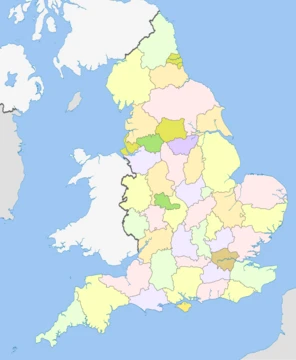
Buckinghamshire
Ceremonial county in South East England, home to Chiltern Hills.
Buckinghamshire (abbreviated Bucks) is a ceremonial county in South East England. It is one of the home counties and has a history dating back to the Brittonic and Roman periods, though the Anglo-Saxons had the greatest impact on its geography. The county is known for its Chiltern Hills, an Area of Outstanding Natural Beauty, and for being the location of Pinewood Film Studios, Dorney rowing lake, and part of Silverstone race track.
- area
- 1,874 km² (724 sq mi)
- estimated_population_2024
- 884,656
- largest_settlement
- Milton Keynes
- highest_point
- Haddington Hill (267 m / 876 ft)
- ceremonial_county_status
- Yes
- unitary_authorities
- Buckinghamshire Council and Milton Keynes City Council
Lore & Background
The name Buckinghamshire is Anglo-Saxon in origin, meaning 'the district of Bucca's home,' referring to Buckingham and named after the landowner Bucca. The county has existed since it was a subdivision of the kingdom of Mercia (585–919) and has been so named since about the 12th century. Historically, the county included the towns of Slough and Eton, and its borders have since changed. The English Civil War was reputedly started by John Hampden in mid-Bucks, and King Henry VIII intervened in local politics in the 16th century. In the 19th century, cholera and famine forced many to migrate to larger towns, and Buckinghamshire became a popular home for London commuters. The expansion of London and the railways promoted the growth of towns in the south, such as Aylesbury, Amersham, and High Wycombe, leaving Buckingham itself a relative backwater.
Reader's Guide
Buckinghamshire's significance lies in its blend of historic rural character and modern urban development. The county contains the Chiltern Hills, an Area of Outstanding Natural Beauty, and the River Thames forms part of its southern boundary. Economically, agriculture predominates after service industries, and many national companies have headquarters or major centres in Milton Keynes. The county is also home to notable amenities such as Pinewood Film Studios and Dorney rowing lake. Politically, the ceremonial county comprises two unitary authorities: Buckinghamshire Council and Milton Keynes City Council. The county's history includes Anglo-Saxon origins, involvement in the English Civil War, and transformation during the 19th century due to migration and railway expansion. Today, Buckinghamshire is ethnically diverse, particularly in larger towns like High Wycombe, which has large Asian and Afro-Caribbean populations.
Did You Know?
- The highest point in Buckinghamshire is Haddington Hill at 267 m (876 ft) above sea level.
- The county includes parts of two of the four longest rivers in England: the Thames and the Great Ouse.
- Buckinghamshire County Council was founded in 1889 with its base in Aylesbury.
- During the Second World War, there were Polish settlements in Bucks, Czechs in Aston Abbotts and Wingrave, and Albanians in Frieth.
More in English Counties 25-39
Elsewhere in the English Counties universe
Spotted an error? Know more?
This is a living reference — every entry is fact-audited, and reader corrections feed straight into our audit queue. Suggest an edit · See this site's audit record