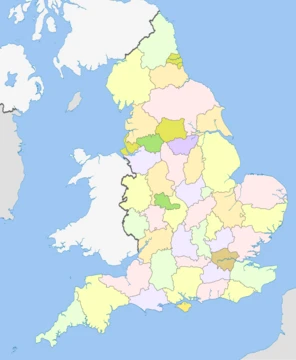
Northumberland
Northernmost English county, shaped by border conflicts and industry.
Northumberland is a ceremonial county in North East England, on the border with Scotland. It is the northernmost county in England and the least-densely populated, with a population estimated at 331,420 in 2024. Its history has been defined by its position on a border, from the Roman era through the Early Modern period, leading to the construction of many castles, peel towers, and bastle houses.
- area
- 5,013 km² (1,936 sq mi)
- population_2024_estimate
- 331,420
- largest_settlement
- Blyth
- administrative_centre
- Morpeth
- highest_point
- The Cheviot (815 m / 2,674 ft)
- notable_features
- Northumberland National Park, Northumberland Coast, part of North Pennines
Lore & Background
Northumberland's name is recorded in the Anglo-Saxon Chronicle as norð hẏmbra land, meaning 'the land north of the Humber'. The region has a rich prehistory with rock art, hillforts such as Yeavering Bell, and stone circles like the Goatstones and Duddo Five Stones. During the Roman occupation, most of the present county lay north of Hadrian's Wall, and nearly 2,000-year-old Roman boxing gloves were uncovered at Vindolanda in 2017.
Present-day Northumberland formed the core of the Anglian kingdom of Bernicia from about 547, later united with Deira to form the kingdom of Northumbria in the 7th century. It is often called the 'cradle of Christianity' in England because Christianity flourished on Lindisfarne after King Oswald of Northumbria invited monks from Iona. The county has more castles than any other in England, including Alnwick, Bamburgh, Dunstanburgh, Newcastle, and Warkworth.
During the Industrial Revolution, Northumberland had significant coal mining, shipbuilding, and armaments industries. The county played a key role in the development of the first railways, driven by the need to transport coal from collieries to the Tyne. After the widespread closures in the 1970s and 1980s, Northumberland remains largely rural and has seen considerable growth in tourism.
Reader's Guide
Northumberland's significance lies in its dual role as a borderland and an industrial heartland. Its position on the Anglo-Scottish border shaped centuries of conflict, resulting in an extraordinary concentration of castles and fortifications, and a history of revolt and rebellion, including the Rising of the North (1569–1570). The county was also a centre for Roman Catholicism and Jacobite support after the Restoration. Its association with Celtic Christianity, particularly through Lindisfarne and the Lindisfarne Gospels, marks it as a key site in early English religious history.
Economically, Northumberland's coalfields fuelled the Industrial Revolution, and its collieries, shipbuilding, and armaments industries were vital until deindustrialisation in the 1980s. Today, the county is the least densely populated in England, with a largely rural character. Its scenic beauty and historical sites, including Northumberland National Park and the Northumberland Coast, attract significant tourism. The county's legacy is preserved in its landscape, from Roman roads and medieval castles to the remains of its industrial past.
Did You Know?
- Northumberland has more castles than any other county in England, including Alnwick, Bamburgh, Dunstanburgh, Newcastle, and Warkworth.
- Nearly 2,000-year-old Roman boxing gloves, similar in style to modern full-hand gloves, were uncovered at Vindolanda in 2017.
- The name Northumberland means 'the land north of the Humber', recorded in the Anglo-Saxon Chronicle.
- The county contains the source of the River North Tyne and much of the South Tyne, which combine near Hexham to form the River Tyne.
More in English Counties 25-39
Elsewhere in the English Counties universe
Spotted an error? Know more?
This is a living reference — every entry is fact-audited, and reader corrections feed straight into our audit queue. Suggest an edit · See this site's audit record