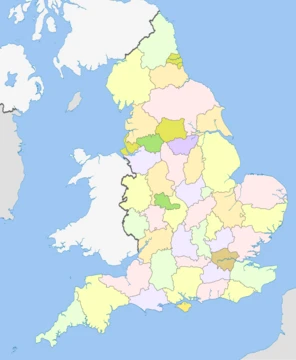
Sussex
Historic kingdom and county of South East England.
Sussex, pronounced /ˈsʌsɪks/, takes its name from the Old English *Sūþseaxe*, meaning "South Saxons." This region in South East England once existed as a kingdom and later as a county. Its history begins in the fifth century, when it arose in lands earlier held by the Regni tribe during the Romano-British period. Around 827, following the Battle of Ellendun, Wessex conquered Sussex. From 860 onward, Wessex kings ruled it, and by 927 it had become part of the Kingdom of England. Today, the ceremonial counties of East Sussex and West Sussex cover roughly the same ground. To the north, Sussex borders Surrey; to the northeast, Kent; to the south, the English Channel; and to the west, Hampshire. Within its bounds lie the city of Brighton and Hove and its wider urban area, sections of the South Downs National Park and the High Weald national landscape, and Chichester Harbour. Its coastline stretches 137 miles (220 km).
During the Norman period, Sussex was split into six administrative districts called rapes, each further divided into hundreds. By the sixteenth century, the eastern three rapes and western three rapes were combined for most quarter sessions court meetings—a division reinforced when the administrative counties of East and West Sussex were created in 1889. Later local government reforms kept this east–west split. Until 1974, Sussex had a single lord lieutenant and sheriff; that year, separate posts for East and West Sussex replaced them, and Sussex lost its ceremonial county status. For some purposes—such as certain public services, food and drink, and sport—Sussex is still treated as one entity. In 2007, Sussex Day was established to honor the county’s culture and history. In February 2025, the UK Government approved plans to devolve powers to a new combined county authority for East Sussex, West Sussex, and Brighton and Hove, led by a directly elected mayor.
The name "Sussex" comes from Middle English *Suth-sæxe*, itself from Old English *Sūþseaxe*, meaning "(land or people) of the South Saxons"—similar to Essex, Middlesex, and Wessex. The South Saxons, a Germanic tribe, settled the area from the North German Plain in the fifth and sixth centuries. The earliest known use of "South Saxons" (Latin: *Australes Saxones*) appears in a royal charter from 689, naming them and their king, Noðhelm, though the term may have been older. A monastic chronicler
- established
- 5th century
- conquered_by_Wessex
- c. 827
- part_of_Kingdom_of_England
- 927
- ceremonial_counties
- East Sussex and West Sussex
- population_2021
- about 1.7 million
- highest_point
- Blackdown, 280 metres
- county_flower
- Round-headed rampion (Pride of Sussex)
Lore & Background
The Kingdom of Sussex emerged in the fifth century in the area that had previously been inhabited by the Regni tribe in the Romano-British period. In about 827, shortly after the Battle of Ellendun, Sussex was conquered by Wessex. From 860 it was ruled by the kings of Wessex, and in 927 it became part of the Kingdom of England. By the Norman period, Sussex was subdivided into six administrative districts known as rapes, which were themselves divided into hundreds. By the sixteenth century, the eastern three rapes and the western three rapes had been combined for most meetings of the court of quarter sessions, a division which was reinforced when the administrative counties of East Sussex and West Sussex were established in 1889. The county retained a single lord lieutenant and sheriff until 1974, when they were replaced with separate posts for East and West Sussex and Sussex lost its status as a ceremonial county.
Reader's Guide
Sussex is widely regarded as a single unified entity for some purposes, including provision of some public services, food and drink and sport. In 2007, Sussex Day was created to celebrate the county's culture and history. In February 2025, the UK Government approved plans to devolve powers to a new combined county authority for East Sussex, West Sussex, and Brighton and Hove, to be headed by a directly elected mayor. The flag of Sussex consists of six gold martlets on a blue background, recognised by the Flag Institute in 2011. The county's motto, 'We wunt be druv', reflects the traditionally independent nature of Sussex men and women. The coastal resorts of Sussex and neighbouring Hampshire are the sunniest places in the United Kingdom, with approximately 1,900 hours of sunshine a year.
Did You Know?
- The name Sussex derives from Old English Sūþseaxe, meaning 'South Saxons'.
- Sussex's coastline is 137 miles (220 km) long.
- The county's unofficial anthem is 'Sussex by the Sea', composed in 1907.
- Three US counties (in Delaware, New Jersey, and Virginia) are named after Sussex.
More in English Counties 1-24
Elsewhere in the English Counties universe
Spotted an error? Know more?
This is a living reference — every entry is fact-audited, and reader corrections feed straight into our audit queue. Suggest an edit · See this site's audit record