Shropshire
Ceremonial county in the West Midlands of England.
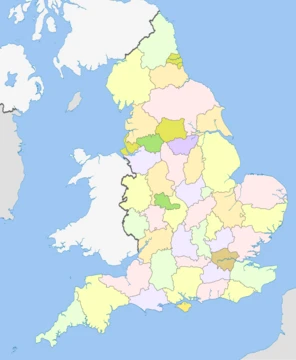
Shropshire (also known as Salop) is a ceremonial county in England’s West Midlands, sitting along the Welsh border. Its neighbours are Cheshire to the north-east, Staffordshire to the east, Worcestershire to the south-east, Herefordshire to the south, and the Welsh areas of Powys and Wrexham to the west and north-west. The biggest settlement is Telford, while Shrewsbury serves as the county town. Covering 3,487 square kilometres, the county had an estimated population of 528,407 in 2024. Beyond Telford and Shrewsbury, the county is largely rural, with market towns like Oswestry in the north-west, Market Drayton in the north-east, Bridgnorth in the south-east, and Ludlow in the south. For local government, it is split into the unitary authorities of Shropshire and Telford and Wrekin. Historically, the county included a large exclave around Halesowen and Oldbury, now part of the West Midlands county.
The landscape varies widely. The south-west and far west are upland, with the Shropshire Hills covering much of that area—home to the Stiperstones, Clee Hills, Long Mynd plateau, and Wenlock Edge escarpment. These hills, along with the isolated Wrekin west of Telford, form a designated national landscape. To the west lies the upland Clun Forest, and the far north-west holds the Oswestry uplands. The north is a plain, and the far north includes Whixall Moss, part of a national nature reserve. The south-east is a sandstone plateau that feeds into the River Severn, the county’s major river, which enters from the west, flows through Shrewsbury, then turns south-east and leaves the county into Worcestershire south of Bridgnorth.
Human activity in Shropshire goes back millennia. Neolithic and Bronze Age occupation is evident, including the Shropshire bulla pendant. The hillfort at Old Oswestry dates from the Iron Age, and the Roman city of Viroconium Cornoviorum left substantial remains. In the Anglo-Saxon period, the area was part of Mercia. During the High Middle Ages, it belonged to the Welsh Marches, the border region between England and Wales. From 1472 to 1689, Ludlow housed the Council of Wales and the Marches, which administered justice across Wales and several English counties. In the English Civil War, Shropshire sided with the Royalists, and after his defeat at the Battle of Worcester, Charles II fled through the county, famously hiding in an oak tree. The
- area
- 3,487 km2 (1,346 square miles)
- estimated_population_2024
- 528,407
- largest_settlement
- Telford
- county_town
- Shrewsbury
- major_river
- Severn
- national_landscape
- Shropshire Hills (including the Wrekin)
Lore & Background
Shropshire has evidence of Neolithic and Bronze Age human occupation, including the Shropshire bulla pendant. The hillfort at Old Oswestry dates from the Iron Age, and the remains of the Roman city of Viroconium Cornoviorum are located within the county. During the Anglo-Saxon era the area was part of Mercia, and in the High Middle Ages it was part of the Welsh Marches; from 1472 to 1689 Ludlow was the seat of the Council of Wales and the Marches.
Reader's Guide
Shropshire's significance lies in its long history as a border region between England and Wales, its role in the Industrial Revolution, and its preservation of prehistoric and Roman sites. The county was a Royalist stronghold during the English Civil War, and Charles II fled through it after the Battle of Worcester. The area around Coalbrookdale is regarded as one of the birthplaces of the Industrial Revolution and has been designated a UNESCO World Heritage Site. For local government purposes the county comprises the unitary authority areas of Shropshire and Telford and Wrekin.
Did You Know?
- The Shropshire bulla is a Late Bronze Age gold pendant found by a metal detectorist in 2018.
- Ludlow was the seat of the Council of Wales and the Marches from 1472 to 1689.
- Charles II famously hid in an oak tree in Shropshire after his defeat at the Battle of Worcester.
- The area around Coalbrookdale is a UNESCO World Heritage Site and a birthplace of the Industrial Revolution.
More in English Counties 25-39
Elsewhere in the English Counties universe
Spotted an error? Know more?
This is a living reference — every entry is fact-audited, and reader corrections feed straight into our audit queue. Suggest an edit · See this site's audit record