Warwickshire
Ceremonial county in the West Midlands of England.
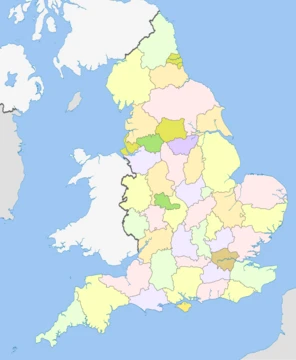
Warwickshire (often shortened to Warks) is a ceremonial county in England’s West Midlands. It shares borders with Staffordshire and Leicestershire to the north, Northamptonshire to the east, Oxfordshire and Gloucestershire to the south, and Worcestershire plus the West Midlands county to the west. Its biggest town is Nuneaton. The county is mostly rural, covering 763 square miles, and had an estimated population of 632,207 in 2024. Key towns include Nuneaton, Bedworth, Rugby, Stratford-upon-Avon, Warwick, and Leamington Spa. For local government, Warwickshire is a non-metropolitan county split into five districts. In the past, the county also included the city of Coventry and areas west of it, such as Sutton Coldfield, Solihull, and central Birmingham.
The landscape is generally flat and low-lying, though the far south reaches into the Cotswolds, which are designated a national landscape. The River Avon, a major tributary of the Severn, flows through the southern part of the county. Historically, the region was part of Roman Britain, and later the Roman road Watling Street marked the boundary between the Anglo-Saxon kingdom of Mercia and the Danelaw. During the Middle Ages and early modern period, the county remained relatively peaceful; Coventry grew into a major centre for textiles. Playwright William Shakespeare was born in Stratford-upon-Avon in 1564 and lived much of his life there, while the Gunpowder Plot of 1605 was planned near Snitterfield. In the Industrial Revolution, the Warwickshire coalfield was mined, and Coventry plus the western part of the county became manufacturing hubs; at the same time, Leamington Spa developed as a tourist resort. Victorian novelist Mary Ann Evans—known as George Eliot—was born just outside Nuneaton in 1819.
Warwickshire’s northern tip lies only 3 miles from the Derbyshire border. The county runs about 56 miles north to south and covers an average-sized English area of 1,975 square kilometres. Most residents live in the north and centre. Northern and eastern market towns—Atherstone, Bedworth, Coleshill, Nuneaton, and Rugby—industrialised in the 19th century, with coal mining, textiles, engineering, and cement production. Heavy industry has since declined, replaced by distribution centres, light industry, and services. Among these towns, Nuneaton and Rugby (the birthplace of rugby football) are best known outside the
- area
- 763 sq mi (1,980 km2)
- population_2024_estimate
- 632,207
- largest_settlement
- Nuneaton
- county_town
- Warwick
- highest_point
- Ebrington Hill, 261 m (856 ft)
- notable_native
- William Shakespeare (born Stratford-upon-Avon, 1564)
- notable_native_2
- George Eliot (born near Nuneaton, 1819)
Lore & Background
Warwickshire came into being as a division of the kingdom of Mercia in the early 11th century, first referenced in 1001 as Wæringscīr, named after Warwick. The region was part of Roman Britain, and later Watling Street became the boundary between Mercia and the Danelaw. The county was relatively settled during the Middle Ages and Early Modern period; Coventry developed as a major textiles centre. William Shakespeare was born in Stratford-upon-Avon in 1564, and the Gunpowder Plot of 1605 was planned near Snitterfield. During the Industrial Revolution, the Warwickshire coalfield was exploited, and Coventry and the west became manufacturing centres; Leamington Spa developed as a tourist resort. The Victorian novelist George Eliot was born just outside Nuneaton in 1819.
Reader's Guide
Warwickshire is significant as a historic county that played a key role in English history, from Roman times through the Industrial Revolution. It is the birthplace of William Shakespeare, the most famous playwright in the English language, and of novelist George Eliot. The county's landscape includes the Cotswolds in the far south, designated a national landscape, and the River Avon flows through the south. Economically, Warwickshire has a strong automotive industry, with BMW, Jaguar Land Rover, and Aston Martin Lagonda facilities, and a growing video game sector centered on 'Silicon Spa' around Leamington Spa and Warwick. Tourism is also important, generating over £1 billion annually. The county's historic boundaries included Coventry, Solihull, and parts of Birmingham, but since 1974 these have been part of the West Midlands county. Warwickshire's flag, a bear and ragged staff on a red field, was registered in October 2016.
Did You Know?
- The highest point in Warwickshire is Ebrington Hill at 261 m (856 ft), on the border with Gloucestershire.
- William Shakespeare was born in Stratford-upon-Avon in 1564 and lived much of his life there.
- The Gunpowder Plot of 1605 was planned near Snitterfield in Warwickshire.
- Warwickshire's flag, featuring a bear and ragged staff on a red field, was registered in October 2016.
More in English Counties 25-39
Elsewhere in the English Counties universe
Spotted an error? Know more?
This is a living reference — every entry is fact-audited, and reader corrections feed straight into our audit queue. Suggest an edit · See this site's audit record