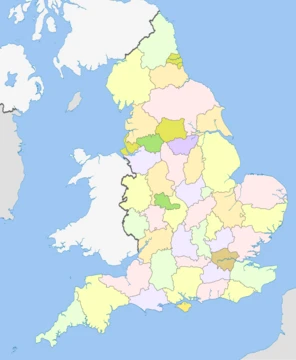
Herefordshire
Rural ceremonial county in the West Midlands of England.
Herefordshire is a ceremonial county in the West Midlands of England, bordered by Shropshire, Worcestershire, Gloucestershire, and the Welsh counties of Monmouthshire and Powys. It is a rural area known for its agricultural land, fruit and cider production, and the Hereford cattle breed, with the city of Hereford as its largest settlement.
- Area
- 2,180 square kilometres (840 sq mi)
- Population (2024 estimate)
- 191,047
- Highest point
- Black Mountain (Twyn Llech), 703.6 metres (2,308 ft)
- County town
- Hereford
- Major rivers
- River Wye and River Lugg
- National landscapes
- Malvern Hills and Wye Valley
Lore & Background
Herefordshire is one of the 39 historic counties of England. Herefordshire County Council was created in 1889. In 1974, the administrative county was merged with Worcestershire to form Hereford and Worcester, but the county was dissolved in 1998, resulting in the return of Herefordshire and Worcestershire as separate counties. The re-established border was almost identical to the pre-1974 boundary, except for a small area at Park Wood transferred to Worcestershire in 1986.
The county is notably hilly, with the River Wye flowing through Hereford and Ross-on-Wye. The land use is mostly agricultural, and the county is known for its fruit and cider production. Bulmers Cider in Hereford is the world's largest cider factory, and Weston's Cider is based in Much Marcle. The county also hosts the UK's largest manufacturer of electricity pylons, Painter Brothers, and the world's largest earth station at BT's Madley Communications Centre.
Gypsies and Travellers have historically been Herefordshire's largest minority ethnic group, numbering 600 people as of the 2021 census. The population increased by 2.0% from 2011 to 2021, lower than the overall increase for England. Most employment is in agriculture, manufacturing, and services.
Reader's Guide
Herefordshire's significance lies in its role as a historic county and a unitary authority area, with a strong agricultural economy centered on fruit and cider production. The county is home to major industrial sites such as Bulmers Cider, the world's largest cider factory, and Painter Brothers, the UK's largest manufacturer of electricity pylons. The county's rural character is preserved through two Areas of Outstanding Natural Beauty: the Malvern Hills and the Wye Valley. Herefordshire's history as part of the Welsh Marches and its re-establishment as a county in 1998 after a period of merger with Worcestershire highlight its enduring identity. The county's demographic trends show a slower population growth than England overall, with a significant 'White Other' group from central and Eastern Europe. Politically, Herefordshire is represented by two parliamentary constituencies, with a Green Party member for North Herefordshire and a Conservative member for Hereford and South Herefordshire as of July 2024.
Did You Know?
- Herefordshire is one of the 39 historic counties of England.
- Bulmers Cider in Hereford is the world's largest cider factory.
- The highest point in Herefordshire is Black Mountain (Twyn Llech) at 703.6 metres.
- The county's population increased by 2.0% from 2011 to 2021.
More in English Counties 1-24
Elsewhere in the English Counties universe
Spotted an error? Know more?
This is a living reference — every entry is fact-audited, and reader corrections feed straight into our audit queue. Suggest an edit · See this site's audit record