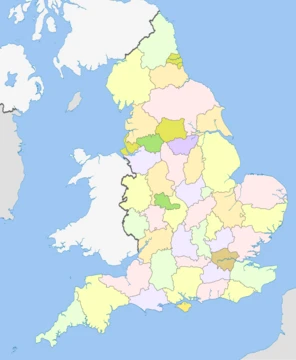
Staffordshire
Ceremonial county in the West Midlands of England.
Staffordshire is a ceremonial county in the West Midlands of England. It is historically significant for its role in the Industrial Revolution, particularly through the exploitation of the North Staffordshire coalfield and the development of the pottery industry, with Stoke-on-Trent becoming the largest settlement and a global center for ceramics.
- area
- 1,713 square kilometres (661 sq mi)
- population_2024
- 1,177,578
- largest_settlement
- Stoke-on-Trent
- county_town
- Stafford
- established
- Early tenth century
- symbol
- Stafford knot
Lore & Background
Staffordshire was formed in the early tenth century, when Stafford became the capital of Mercia. The county contains Iron Age tumuli and Roman camps, and was settled by the Angles in the sixth century; the oldest Stafford knot appears on an Anglian cross in Stoke Minster churchyard. Historically, it was divided into five hundreds: Cuttlestone, Offlow, Pirehill, Seisdon, and Totmonslow.
The county rapidly industrialised during the Industrial Revolution, fueled by the North Staffordshire coalfield. Pottery became its most famous export, with limited production still occurring in Stoke-on-Trent. The historic boundaries included much of what is now the West Midlands county, including Walsall, West Bromwich, and Wolverhampton. Significant boundary changes occurred in 1926 and 1966, and under the Local Government Act 1972, the Black Country area became part of the new metropolitan county of West Midlands.
In July 2009, the largest hoard of Anglo-Saxon gold ever found in Britain was discovered near Lichfield. The artefacts, known as the Staffordshire Hoard, have been tentatively dated to the 7th or 8th centuries, placing their origin in the time of the Kingdom of Mercia.
Reader's Guide
Staffordshire's significance lies in its industrial heritage and its role as a center for pottery and ceramics, particularly through Stoke-on-Trent. The county's coalfields powered the iron and automobile industries in the south during the Industrial Revolution. Its administrative history reflects the complex evolution of English local government, with the creation of county boroughs and later the unitary authority of Stoke-on-Trent in 1997. The county is also notable for its sporting contributions, including Stoke City, one of the oldest professional football clubs, and Staffordshire County Cricket Club, the most successful team in the Minor Counties Championship. The discovery of the Staffordshire Hoard in 2009 added significant archaeological importance, providing insight into Anglo-Saxon Mercia. Geographically, the county features the southern Pennines, Cannock Chase AONB, and parts of the National Forest, drained by the River Trent and its tributaries.
Did You Know?
- The largest hoard of Anglo-Saxon gold ever found in Britain was discovered in a field near Lichfield in July 2009.
- Stoke City was among the 12 founder members of the Football League in 1888.
- Staffordshire County Cricket Club has won the Minor Counties Championship outright eleven times, making it the most successful team in the competition.
- The oldest Stafford knot can be seen on an Anglian cross in the churchyard of Stoke Minster.
More in English Counties 1-24
Elsewhere in the English Counties universe
Spotted an error? Know more?
This is a living reference — every entry is fact-audited, and reader corrections feed straight into our audit queue. Suggest an edit · See this site's audit record