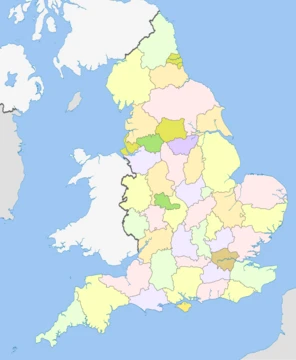
Leicestershire
A historic East Midlands county with diverse landscapes and industry.
Leicestershire is a ceremonial county in the East Midlands of England, bordered by Derbyshire, Nottinghamshire, Lincolnshire, Rutland, Northamptonshire, Warwickshire, and Staffordshire. The city of Leicester is its largest settlement. The county has an area of 2,156 km² and an estimated population of 1,133,921 in 2024. It is a lowland county bisected by the River Soar, with Charnwood Forest to the west and Bardon Hill as its highest point at 278 m. Historically, Leicestershire was part of the Kingdom of Mercia, recorded in the Domesday Survey, and was the site of the Battle of Bosworth Field in 1485, which established the Tudor dynasty. The county is known for its role in fox hunting, Stilton cheese, Melton Mowbray pork pies, and manufacturing, including shoemaking in Leicester and engineering in Loughborough.
- type
- Ceremonial county
- area
- 2,156 km² (832 sq mi)
- population_2024
- 1,133,921
- largest_settlement
- Leicester
- highest_point
- Bardon Hill, 278 m (912 ft)
- known_for
- Battle of Bosworth Field, fox hunting, Stilton cheese, Melton Mowbray pork pies, engineering
Lore & Background
Leicestershire's recorded history begins with prehistoric earthworks and a Roman settlement at Leicester. The region was settled by Angles in the sixth century and became part of the Kingdom of Mercia. The county existed at the time of the Domesday Survey in the 1080s, which recorded four wapentakes: Guthlaxton, Framland, Goscote, and Gartree. These later became hundreds, with Goscote divided into West and East Goscote, and the addition of Sparkenhoe hundred. The first recorded use of the county name occurs in 1087 as Lægrecastrescir. The county's external boundaries have changed little since the Domesday Survey, with minor exchanges such as the Measham-Donisthorpe exclave for the Netherseal area and the annexation of Little Bowden from Northamptonshire due to urban expansion of Market Harborough.
Reader's Guide
Leicestershire's significance lies in its blend of historical events, cultural traditions, and industrial heritage. The Battle of Bosworth Field in 1485 marked a pivotal moment in English history, establishing the Tudor dynasty. The county is traditionally regarded as the birthplace of modern fox hunting, with Hugo Meynell known as the 'father of modern fox-hunting,' and towns like Melton Mowbray and Market Harborough associated with the sport. During the Industrial Revolution, the Leicestershire coalfield was exploited, and Leicester became known for shoemaking. Engineering has long been important, with companies such as John Taylor Bellfounders in Loughborough, which cast 'Great Paul' for St Paul's Cathedral in 1881, and Norman & Underwood, which has worked on major cathedrals since 1825. Modern engineering firms include Triumph Motorcycles, Noble Automotive, and Brush Traction. Agriculture contributes Stilton cheese and Melton Mowbray pork pies. The geographical centre of England is in Leicestershire, near Fenny Drayton, as calculated by the Ordnance Survey in 2013.
Did You Know?
- The first recorded use of the county name occurs in 1087 as Lægrecastrescir.
- The county's highest point is Bardon Hill at 278 m (912 ft), which is also a Marilyn.
- The geographical centre of England is in Leicestershire, near Fenny Drayton, calculated by the Ordnance Survey in 2013.
- Until 1969, the county's legal name was 'Leicester' rather than 'Leicestershire'.
More in English Counties 1-24
Elsewhere in the English Counties universe
Spotted an error? Know more?
This is a living reference — every entry is fact-audited, and reader corrections feed straight into our audit queue. Suggest an edit · See this site's audit record