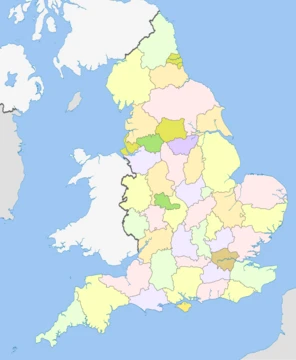
Hertfordshire
Historic county north of London, home to Roman ruins and garden cities.
Hertfordshire is a ceremonial county in the East of England, bordered by Bedfordshire, Cambridgeshire, Essex, Greater London, and Buckinghamshire. Its largest settlement is Watford, and it has been historically significant as the site of Roman Verulamium, the drafting of Magna Carta, and the first garden city at Letchworth.
- area
- 634 square miles (1,640 km2)
- estimated_population_2024
- 1,236,191
- largest_settlement
- Watford
- highest_point
- 244 m (801 ft) on the Ridgeway near Tring
- county_town
- Hertford
- established_as_shire
- 10th century
- patron_saint
- Saint Alban
Lore & Background
Hertfordshire has evidence of human life from the Mesolithic period, with farming in the Neolithic and permanent habitation by the Bronze Age. The Catuvellauni tribe settled during the Iron Age, and after the Roman conquest in AD 43, the town of Verulamium (St Albans) developed. Saint Alban, a Romano-British soldier, was martyred there circa 293, becoming the county's patron saint. Following Roman withdrawal, Anglo-Saxons colonised the area, and by the 6th century most of the modern county was part of the Kingdom of Essex. The region became an English shire in the 10th century after the merger of West Saxon and Mercian kingdoms.
During the Norse invasions, King Edward the Elder built a fort at Hertford in 913. The county suffered raids by Danish kings Swein Forkbeard and Cnut the Great. After the Norman conquest, William of Normandy received the surrender of English lords at Berkhamsted. The Domesday Book recorded nine hundreds. In the Plantagenet period, St Albans Abbey was an initial drafting place for Magna Carta, and two battles of the Wars of the Roses occurred at St Albans. In Tudor times, Queen Elizabeth I often visited Hatfield House. The New River was constructed in the Stuart period to supply London with drinking water.
In 1903, Letchworth became the world's first garden city, and Stevenage was the first town to expand under the New Towns Act 1946. The first zeppelin shot down over Great Britain during WW1 fell at Cuffley. Borehamwood housed major film studios, including MGM-British Studios, where the first three Star Wars films were made. Warner Bros. Studios at Leavesden hosted the Harry Potter series and the James Bond film GoldenEye. The Hatfield rail crash in 2000 and the Potters Bar rail accident in 2002 were notable disasters, as were the Buncefield oil storage explosions in 2005.
Reader's Guide
Hertfordshire's significance lies in its layered history from prehistoric times through Roman, Anglo-Saxon, Norman, and modern eras. It contains the Roman town of Verulamium, the medieval St Albans Abbey, and Tudor Hatfield House. The county played a role in the drafting of Magna Carta and was a battleground in the Wars of the Roses. Its modern legacy includes pioneering urban planning with Letchworth, the first garden city, and Stevenage, the first New Town. The county's film studios at Borehamwood and Leavesden have produced globally recognized films, including Star Wars and Harry Potter. Hertfordshire's proximity to London has shaped its economy, with many residents commuting to the capital. The county's geography features the Chilterns, the rivers Lea and Colne, and extensive Metropolitan green belt. Its population in 2024 was estimated at 1,236,191, with Watford as the largest settlement. The county's flag and coat of arms feature a yellow saltire on a blue field, reflecting Saint Alban's martyr's cross, and a hart (deer) representing the county's name.
Did You Know?
- The name Hertfordshire is first recorded in the Anglo-Saxon Chronicle in 1011.
- Saint Alban, the patron saint of Hertfordshire, was martyred at Verulamium circa 293.
- Letchworth, founded in 1903, was the world's first garden city.
- The first three Star Wars films were made at the MGM-British Studios in Borehamwood.
More in English Counties 1-24
Elsewhere in the English Counties universe
Spotted an error? Know more?
This is a living reference — every entry is fact-audited, and reader corrections feed straight into our audit queue. Suggest an edit · See this site's audit record