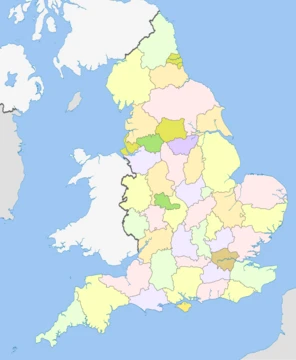
Northamptonshire
Ceremonial county in the East Midlands of England.
Northamptonshire is a ceremonial county in the East Midlands of England, bordered by several other counties and with Northampton as its largest settlement. Historically part of the Danelaw and later a center of the footwear industry, the county played a role in key battles of the Wars of the Roses and the English Civil War.
- Area
- 2,364 km² (913 sq mi)
- Population (2024 est.)
- 813,682
- Highest point
- Arbury Hill, 225 m (738 ft)
- Principal river
- River Nene
- Largest settlement
- Northampton
- Historic county town
- Northampton
- Notable battle
- Battle of Naseby (1645)
Lore & Background
Northamptonshire's early history includes Iron Age hill-forts such as Hunsbury Hill and Roman settlements like Lactodurum (modern Towcester). After the Romans left, the area became part of the Anglo-Saxon kingdom of Mercia, and from about 889 it was part of the Danelaw until recaptured by Edward the Elder in 917. The county was first recorded in the Anglo-Saxon Chronicle in 1011 as Hamtunscire, with 'North' added to distinguish it from Southampton.
During the later Middle Ages, the county saw the Battle of Northampton in 1460 during the Wars of the Roses, where King Henry VI was captured. In the English Civil War, Northamptonshire strongly supported Parliament, and the Royalist army was decisively defeated at the Battle of Naseby in 1645. King Charles I was later imprisoned at Holdenby House in 1647.
In the 18th and 19th centuries, the county became a major center for shoemaking and leather industries. The town of Corby was established as a major steel center during the 1930s. The county historically included the Soke of Peterborough, which was transferred to Cambridgeshire in 1974.
Reader's Guide
Northamptonshire's significance lies in its role as a crossroads of English history, from Iron Age settlements and Roman roads to key battles of the Wars of the Roses and the English Civil War. The county's name originates from the Danelaw, and it was one of the Five Boroughs controlled from Northampton. Its industrial heritage includes being a major center for footwear and leather in the 19th century, and later for steel in Corby. The county is also known for its many stately homes and ancient churches, earning it the nickname 'county of spires and squires.' The area has connections to George Washington, whose ancestors emigrated from Northamptonshire to Virginia in 1656. For local government, the county is divided into two unitary authorities: North Northamptonshire and West Northamptonshire. Since 1965, Northamptonshire has been one of the few English counties without a city.
Did You Know?
- Northamptonshire was first recorded in the Anglo-Saxon Chronicle in 1011 as Hamtunscire.
- The county's highest point is Arbury Hill at 225 m (738 ft).
- The Battle of Naseby in 1645 destroyed the main Royalist army during the First English Civil War.
- George Washington's ancestors emigrated from Northamptonshire to Virginia in 1656.
More in English Counties 1-24
Elsewhere in the English Counties universe
Spotted an error? Know more?
This is a living reference — every entry is fact-audited, and reader corrections feed straight into our audit queue. Suggest an edit · See this site's audit record