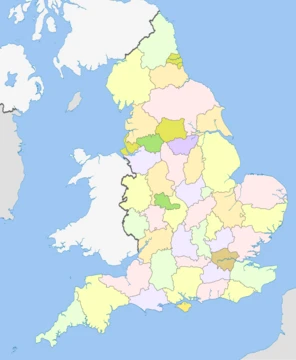
Suffolk
Ceremonial county in East Anglia with rich archaeology and arable land.
Suffolk is a ceremonial county in the East of England and East Anglia, bordered by Norfolk, the North Sea, Essex, and Cambridgeshire. Its largest settlement is Ipswich, and it is known for extensive farming, a complex coastline, and significant archaeological sites spanning from the Lower Paleolithic to the medieval period.
- area
- 3,798 km² (1,466 sq mi)
- population_2024_estimate
- 786,231
- largest_settlement
- Ipswich
- county_town
- Ipswich
- known_for
- Sutton Hoo ship burial, Hoxne Hoard, horse racing at Newmarket, container port at Felixstowe
Lore & Background
Suffolk's history includes some of the earliest evidence of human activity in northern Europe, with artefacts dating to around 70,000 years ago found at Pakefield and Beeches Pit. In the Roman period, most of Suffolk was inhabited by the Iceni tribe, who revolted under Boudica in AD 60–61. The area later became part of the Kingdom of East Anglia, and its most celebrated Anglo-Saxon site, Sutton Hoo, was an elaborate royal ship burial, probably of King Rædwald. The county of Suffolk was formed in the 10th or 11th century and was reorganized under Norman feudalism after 1066, with castles at Framlingham, Clare, and Eye. The abbey at Bury St Edmunds became one of the wealthiest religious institutions in medieval England.
Reader's Guide
Suffolk's significance lies in its archaeological wealth and its role in English history from prehistory through the medieval period. The 1797 discovery by John Frere of flint hand axes at Hoxne Brick Pit was a formative episode in English archaeology, being the earliest recognition that hand axes were made by early humans, over sixty years before the antiquity of humanity was widely appreciated. The Hoxne Hoard, found in 1992, remains the largest assembly of late Roman silver and gold discovered in Britain. Sutton Hoo provides one of England's most significant Anglo-Saxon archaeological finds. In modern times, Suffolk's economy evolved with agriculture, fishing, and maritime trade, and it is home to Felixstowe, one of the largest container ports in Europe. The county's historic sites, churches, and coastal landscapes continue to shape its identity, while its coastline, including parts of the Suffolk & Essex Coast & Heaths National Landscape, is susceptible to erosion and contains deep estuaries and heath habitats.
Did You Know?
- Artefacts dating to around 70,000 years ago found at Pakefield and Beeches Pit are among the earliest evidence of human activity in northern Europe.
- The Hoxne Hoard, found in 1992, is the largest assembly of late Roman silver and gold discovered in Britain.
- Sutton Hoo was an elaborate royal ship burial, probably of the East Anglian King Rædwald.
- In 2020, a survey named Suffolk the third best place in the UK for aspiring archaeologists.
More in English Counties 1-24
Elsewhere in the English Counties universe
Spotted an error? Know more?
This is a living reference — every entry is fact-audited, and reader corrections feed straight into our audit queue. Suggest an edit · See this site's audit record