Kent
A historic county at England's gateway to mainland Europe.
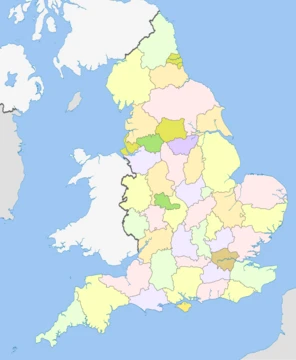
Kent is a ceremonial county located in South East England. To its north lies Essex, separated by the Thames Estuary; the Strait of Dover borders it to the south-east; East Sussex lies to the south-west; Surrey to the west; and Greater London to the north-west. Covering 3,544 square kilometres, the county had an estimated population of 1,931,684 in 2024. The north-western part is densely populated: Dartford and Gravesend are part of the Greater London conurbation, while Chatham, Gillingham, and Rochester form another conurbation around the River Medway. To the south of these sits Maidstone. The rest of the county is more rural, with key settlements including the city of Canterbury in the north-east, the seaside resort of Margate on the north-east coast, and the ports of Dover and Folkestone on the east coast. For local government, Kent is divided into a non-metropolitan county with twelve districts, plus the unitary authority of Medway. Historically, the county included south-east Greater London and is counted among the home counties.
The north of Kent is a plain along the Thames Estuary. To the south lies the North Downs, a chalk downland ridge running from north-west to south-east, forming dramatic chalk cliffs—most notably the White Cliffs of Dover—where it meets the English Channel. The south-west contains parts of the Greensand Ridge and the Weald, the area between the North and South Downs. The south-east features the low-lying Romney Marsh. Both the North Downs and the High Weald have been designated national landscapes. This geography supports fruit orchards, earning Kent the nickname "the Garden of England." In north-west Kent, industries include aggregate extraction, printing, and scientific research; coal mining also forms part of the county’s industrial heritage.
Kent’s position between London and the Strait of Dover—the narrowest crossing between England and mainland Europe—has made it a landing point for many significant figures and groups in British history. It was among the first British territories settled by Germanic tribes, especially the Jutes, after the Romans withdrew. In the 6th century, Saint Augustine arrived in the county to convert England to Christianity and became the first Archbishop of Canterbury; Canterbury Cathedral is now a World Heritage Site. England relied on Kent’s ports for warships over many centuries, notably the Cin
- area
- 3,544 square kilometres (1,368 sq mi)
- population_2024
- 1,931,684
- nickname
- the Garden of England
- motto
- Invicta (meaning 'undefeated' or 'unconquered')
- oldest_recorded_name
- Kantion (c. 320s BC by Pytheas)
Lore & Background
Kent played a major role in several notable rebellions, including the Peasants' Revolt of 1381, Jack Cade's Kent rebellion of 1450, and Wyatt's rebellion of 1554. The Royal Navy used the River Medway from 1547, and Chatham Dockyard became important from the 16th to 20th centuries. Dover Castle has been described as the 'key of England' due to its strategic significance. In 1889, parts of north-west Kent were taken over by the County of London, and in 1894, Kent absorbed parts of Tunbridge Wells and Lamberhurst from East Sussex.
Reader's Guide
Kent's significance lies in its role as a historical gateway between England and mainland Europe, shaping its identity as a point of entry for peoples, cultures, and military forces. The county's early settlement by Germanic tribes, the arrival of Saint Augustine, and its strategic ports and dockyards—such as the Cinque Ports and Chatham Dockyard—underscore its importance in English history. The motto Invicta reflects a tradition of resistance, from the Norman Conquest to various rebellions. Geographically, Kent's varied landscape includes the North Downs, the Weald, and Romney Marsh, supporting fruit orchards and earning it the nickname 'the Garden of England'. Its industrial heritage includes aggregate extraction, printing, scientific research, and coal mining. The county's legacy is preserved in its World Heritage Site at Canterbury Cathedral, its historic castles, and its continued role as a link to continental Europe.
Did You Know?
- Kent's name is first recorded in a periplus by Pytheas around the 320s BC, making it one of the oldest place names in the British Isles still in use.
- The county's motto Invicta means 'undefeated' or 'unconquered', adopted after William the Conqueror was unable to subdue Kent following the Norman Conquest.
- The traditional border between East and West Kent is the River Medway, with those east called Men (or Maids) of Kent and those west called Kentishmen or Kentish Maids.
- The first Ordnance Survey map ever drawn was a one-inch map of Kent, published in 1801.
More in English Counties 1-24
Elsewhere in the English Counties universe
Spotted an error? Know more?
This is a living reference — every entry is fact-audited, and reader corrections feed straight into our audit queue. Suggest an edit · See this site's audit record