Middlesex
Historic English county, largely absorbed into Greater London.
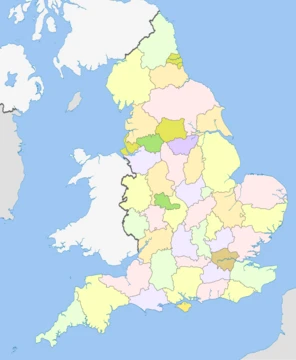
Middlesex is one of the historic counties of England, second smallest after Rutland. Its boundaries largely followed the rivers Thames, Lea, and Colne, with a line of hills forming its northern border with Hertfordshire. The county's name derives from its origin as a homeland for the Middle Saxons in the early Middle Ages. Its former area now lies almost entirely in Greater London, with smaller parts in Hertfordshire and Surrey.
- Type
- Historic county of England
- Area rank
- Second smallest among historic English counties
- Origin
- Homeland of the Middle Saxons
- Boundaries
- Rivers Thames (south), Lea (east), Colne (west); hills to north
- Notable divisions
- Six hundreds: Edmonton, Elthorne, Gore, Hounslow (Isleworth), Ossulstone, Spelthorne
- Key administrative change
- 1889: part became County of London; remainder formed administrative county of Middlesex
- Dissolution
- 1965: almost all area incorporated into Greater London
Lore & Background
Middlesex has its roots in the settlement of the Middle Saxons, a province that likely included much of Hertfordshire. The name means 'territory of the middle Saxons,' from Old English 'middel' and 'Seaxe.' The county is recorded in the Domesday Book of 1086 as divided into six hundreds. The City of London became a self-governing county corporate in the twelfth century, though the sheriffs of London maintained jurisdiction in Middlesex. The Tower Division (Tower Hamlets) had considerable autonomy under its own Lord Lieutenant.
Reader's Guide
Middlesex is significant as one of the historic counties of England, its name preserving the legacy of the Middle Saxons. Its gradual absorption into Greater London, completed in 1965, reflects the immense growth of the metropolis. The county's governance history illustrates the tension between local administration and the expanding capital: the City of London remained separate, the Tower Division enjoyed autonomy, and the Metropolitan Board of Works and Metropolitan Police developed to manage the growing urban area. The creation of the administrative County of London in 1889 and the later formation of Greater London in 1965 effectively dissolved Middlesex as a distinct entity, though its name persists in postal addresses and historical references. The county's boundaries, defined by rivers and hills, shaped the development of London's suburbs.
Did You Know?
- Middlesex is the second smallest historic county in England, after Rutland.
- The name Middlesex means 'territory of the middle Saxons,' from Old English 'middel' and 'Seaxe'.
- The Tower Division (Tower Hamlets) had its own Lord Lieutenant, independent of the Lord Lieutenant of Middlesex.
- In 1889, about twenty per cent of Middlesex's area and a third of its population were transferred to the new administrative County of London.
More in English Counties 1-24
Elsewhere in the English Counties universe
Spotted an error? Know more?
This is a living reference — every entry is fact-audited, and reader corrections feed straight into our audit queue. Suggest an edit · See this site's audit record